Wednesday, 22 February 2012

Birmingham Museums & Art Gallery Pre Raphaelite Drawings


Rosso Vestita ~ Rossetti
Birmingham Museums and Art Gallery has over 2000 works in their collection of Pre-Raphaelite art, including oil paintings, tapestries, drawings, sketchbooks, stained glass and related cartoons, as well as prints, illustrated books, watercolours and ceramics.


Funded by public subscription, over 1000 drawings were bought from the artist and dealer Charles Fairfax Murray in 1903 and 1906 and clearly show how important drawing was to the Pre-Raphaelite vision and way of working.Many of the drawings are by Holman Hunt but there are also several rarely seen works by Ruskin, Millais and Rossetti.  A good example is Rosso Vestita Rosetti's second watercolour which is one of four fragments remaining from a large design for Kate the Queen, which was destroyed by Rossetti.


The collection can be viewed at: http://www.preraphaelites.org/the-collection/view-the-collection/ 

Sunday, 11 December 2011

Ruskin's Mother

Portrait of Margaret Ruskin aged 44 by
James Northcote RA, 1825 

Some understanding of Ruskin's view of the world can be found by learning more about his mother, Margaret. Some accounts state that Margaret's father was a devout puritan named Captain Cox, of Yarmouth, a master mariner who died young. 

It may surprise people to know that Margaret was in fact born on the 2nd of September in 1781 at The King's Head Public House in Croydon where her father, William Cock, was the tenant-landlord. William was also an astute property developer, building a number of cottages that provided the family with a comfortable income. It is true that William died in a riding accident when he was only 33. Margaret's mother was able to use income from the rent of the cottages to send her to Mrs Rice's Academy for Ladies.  It was there that she became an Evangelical Protestant.

In the early 1800's Margaret went to live with her Aunt and Uncle in Edinburgh, where she met and married her cousin, John Ruskin's father, after an engagement of eight years.  John's father made his fortune as a wine importer and was often away on business, so it was his mother who became responsible for his education. His mother taught him to read every part of the Bible each year, including learning long passages by heart.  Her ambition was for him to become the Archbishop of Canterbury, but Margaret also taught John using the works of Sir Walter Scott, Byron and Shakespeare. Accounts describe Margaret as a 'strict disciplinarian' but it seems that she also indulged John, her only child. The family were wealthy and holidayed with trips through Europe. 

The impact of this on Ruskin is hinted at in his letters on education, where he wrote "the first essential point in the education given to the children will be the habit of instant, finely accurate, and totally unreasoning, obedience to their fathers, mothers, and tutors. The second essential will be the understanding of the nature of honour, making the obedience solemn and constant."

Even when John Ruskin was at Oxford for seven years, his mother lived with him, taking lodgings in the High Street to 'watch over his health'. She continued to watch over him until her death aged ninety.  John Ruskin was fifty two and was profoundly affected by her loss.  Margaret Ruskin was buried with her husband in Shirley parish church in Croydon and Ruskin had the following inscribed on her tomb:

Here
Beside my father's body
I have laid
My mother's;
Ever returned to earth,
Nor purer life
Recorded in heaven.

Saturday, 12 November 2011

Ruskin's letter to The Times, 13th May 1851

Sir, Your usual liberality will, I trust, give a place in your columns to this expression of my regret that the tone of the critique which appeared in The Times of Wednesday last on the works of Mr. Millais and Mr. Hunt, now in the Royal Academy, should have been scornful as well as severe.  I regret it, first, because the mere labour bestowed on those works, and their fidelity to a certain order of truth (labour and fidelity which are altogether indisputable) ought at once to have placed them above the level of mere contempt; and, secondly, because I believe these young artists to be at a most critical period of their career—at a turning point, from which they may either sink into nothingness or rise to very real greatness; and I believe also, that whether they choose the upward or downward path may in no small degree depend upon the character of the criticism which their works have to sustain.

I do not wish in any way to dispute or invalidate the general truth of your critique on the Royal Academy; nor am I surprised at the estimate which the writer formed of the pictures in question when rapidly compared with works of totally different style and aim; nay, when I first saw the chief picture by Millais in the Exhibition of last year I had nearly come to the same conclusions myself. But I ask your permission, in justice to artists who have at least given much time and toil to their pictures, to institute some more serious inquiry into their merits and faults than your general notice of the Academy could possibly have admitted.

Let me state, in the first place, that I have no acquaintance with any of these artists, and very imperfect sympathy with them. No one who has met with any of my writings will suspect me of daring to encourage them in their Romanist and Tractarian tendencies. I am glad to see that Mr. Millais's lady in blue is heartily tired of her painted window and idolatrous toilet-table, and I have no particular respect for Mr. Collins' lady in white, because her sympathies are limited by a dead wall, or divided between some gold fish and a tadpole (the latter Mr. Collins may, perhaps, permit me to suggest, en passant, as he is already half a frog, is rather too small for his age). But I happen to have a special acquaintance with the water plant, Alisma Plantago, among which the said gold fish are swimming; and, as I never saw it so thoroughly or so well drawn, I must take leave to remonstrate with you when you say sweepingly, that these men ‘sacrifice truth, as well as feeling to eccentricity.’ For as a mere botanical study of the water lily and Alisma, as well as of the common lily and several other garden flowers, this picture would be invaluable to me, and I heartily wish it were mine.

But, before entering into such particulars, let me correct an impression which your article is likely to induce in most minds, and which is altogether false. These pre-Raphaelites (I cannot compliment them on common sense in choice of a nom de guerre) do not desire nor pretend in any way to imitate antique painting, as such. They know little of ancient paintings who suppose the works of these young artists to resemble them. As far as I can judge of their aim—for, as I said, I do not know the men themselves—the pre-Raphaelites intend to surrender no advantage which the knowledge or inventions of the present time can afford to their art. They intend to return to early days in this one point only—that, as far as in them lies, they will draw either what they see, or what they suppose might have been the actual facts of the scene they desire to represent, irrespective of any conventional rules of picture making; and they have chosen their unfortunate though not inaccurate name because all artists did this before Raphael's time, and after Raphael's time did not this, but sought to paint fair pictures rather than represent stern facts, of which the consequence has been that from Raphael's time to this day historical art has been in acknowledged decadence.

Now, Sir, presupposing that the intention of these men was to return to archaic art instead of to archaic honesty, your critic borrows Fuseli’s expression respecting ancient draperies—‘snapped’ instead of folded,’ and asserts that in these pictures there is a ‘ servile imitation of false perspective.’ To which I have just this to answer: —

Millais' ‘Mariana’ (1851)
That there is not one single error in perspective in four out of the five pictures in question, and that in Millais' ‘Mariana’ there is but this one—that the top of the green curtain in the distant window has too low a vanishing point; and that I will undertake, if need be, to point out and prove a dozen worse errors in perspective in any 12 pictures containing architecture, taken at random from among the works of the most popular painters of the day.

Secondly: that, putting aside the small Mulready and the works of Thorburn and Sir W. Ross, and perhaps some others of those in the miniature room which I have not examined, there is not a single study of drapery in the whole Academy, be it in large works or small, which for perfect truth, power, and finish, could be compared for an instant with the black sleeve of the Julia, or with the velvet on the breast and the chain mail of the Valentine of Mr. Hunt's picture; or with the white draperies on the table in Mr. Millais' ‘Mariana, ’ and of the right hand figure in the same painter's ‘Dove returning to the Ark.’
And further: that as studies both of drapery and of every minor detail, there has been nothing in art so earnest or so complete as these pictures since the days of Albert Durer. This I assert generally and fearlessly. On the other hand,

I am perfectly ready to admit that Mr. Hunt's ‘Silvia’ is not a person whom Proteus or anyone else would have been likely to have fallen in love with at first sight; and that one cannot feel any sincere delight that Mr. Millais' ‘Wives of the Sons of Noah’ should have escaped the Deluge; with many other faults besides on which I will not enlarge at present, because I have already occupied too much of your valuable space, and I hope to be permitted to enter into more specific criticism in a future letter,

I have the honour to be, Sir, your obedient servant,

John Ruskin

Sunday, 30 October 2011

A Passion for the Pre-Raphaelites by Andrew Lloyd Webber

Lord Andrew Lloyd Webber is best known for the musicals that made him a multi-millionaire. He was less well known for his passion in the work of the Pre-Raphaelite Brotherhood - until he presented a documentary where he talks about their work, their lives, and their long term influence.

Growing up in London in the 1960s, he visited local churches and saw the works of Dante Gabriel Rossetti and Edward Burne-Jones in the stained glass windows. He then became a regular visitor to London's Tate Gallery collection in the Pre-Raphaelite gallery.

Interestingly, he explains that unfashionable Victorian paintings could be bought very cheaply at the time. He became wealthy after the hit musical Jesus Christ Superstar in the early 1970's and started what he calls 'serious' art collecting.

He is coy about what it has cost but he has paid record prices at art auctions, paying £17M for a Picasso and his collection includes A Vision of Fiammetta , one of Rossetti's last paintings. Pride of place, of course, goes to one of the eight versions of Rossetti’s ‘Proserpine’.

Andrew Lloyd Webber He makes a good case for their lasting impact not just on art, but also architecture and the way we now think about the Victorians. Disappointingly, he made no mention in the programme of John Ruskin, although there were several opportunities to do so.

The documentary should be available on this link until the 2nd November 2011

Saturday, 1 October 2011

The Last Pre-Raphaelite


Fiona MacCarthy brings us a little closer to understanding Edward Burne-Jones.  You may know her from William Morris: A Life for Our Time and, once again, we are transported to the world of the Victorians.   

As Susan Engel wrote: Context is everything - and Fiona MacCarthy reminds us of the need to interpret Burne-Jones through an appreciation of the Victorian imagination.  It is no coincidence that Fiona Chose The Beguiling of Merlin for the cover - a painting about love and infatuation, entrapment and betrayal. 

The Last Pre-Raphaelite is available on Amazon UK and Amazon US 

Sunday, 17 July 2011

The Pre-Raphaelites Exhibition – London 2012

The Tate Gallery in London has announced a major exhibition of Pre-Raphaelite paintings between the 12th of September 2012 and the 13th of January 2013.

Open from 10am - 6pm daily, the gallery will be exhibiting over 150 works in different media, including painting, sculpture, photography and the applied arts.

The exhibition includes many famous Pre-Raphaelite works rarely seen in the UK,  including Rossetti's Found, (on loan from the Delaware Art Museum) Ophelia by John Everett Millais, The Scapegoat by Holman Hunt, the epic social panorama Work by Ford Madox Brown and Rossetti's Lady Lilith.


Rossetti wrote that his Lady Lilith ". . . represents a Modern Lilith combing out her abundant golden hair and gazing on herself in the glass with that self-absorption by whose strange fascination such natures draw others within their own circle."

The Tate also plans to re-introduce a number of rarely seen masterpieces, including Ford Madox Brown’s polemical Work from 1852-1865 and Philip Webb and Burne-Jones’s The Prioress’s Tale wardrobe of 1858.

The Pre-Raphaelites exhibition London event runs from Wednesday 12th September 2012 - Sunday 13th January 2013. Tate Britain is open from 10am - 6pm daily and is open late until 10pm on the first Friday of every month.

Saturday, 18 June 2011

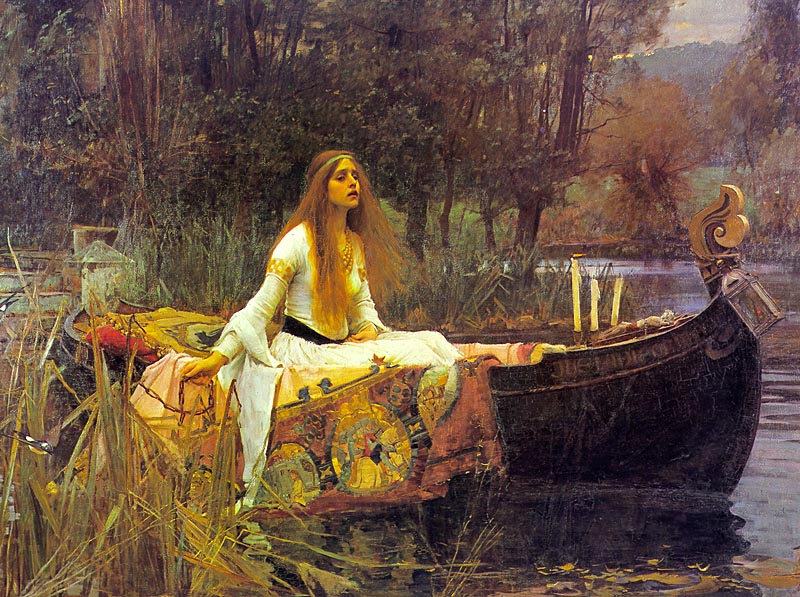
Fascination with The Lady of Shalott

John William Waterhouse

Alfred Tennyson was only 23 when he first published The lady of Shalott and said he got the idea from a 14th century Italian novella, Donna di Scalotta. Hunt and Rossetti were both inspired to illustrate the haunting poem, which tells how the tragic Lady of Shalott must remain in a tower, separated from the outside world and under a spell that means she dies when she escapes.

Abandoning Shalott, her mythical island, the Lady steals a boat and finds time to write her name on the bows before drifting down the river to Camelot to find love. Sadly the curse means she dies before she arrives and is found (too late) by the gallant knight Sir Lancelot.  It is this scene which Dante Gabriel Rossetti chose to illustrate, where all Lancelot's has to say on finding the body is "She has a lovely face".   Rossetti wrote in a letter to Hunt that "illustrated editions of poets, however good are quite hateful things" but this didn't seem to stop him as he made numerous preparatory sketches before he was happy with his woodcut.

Rossetti: The lady of Shalott (Woodcut)  Credit The Rossetti Archive

Hunt’s painting of The Lady of Shalott was his last work, completed at the age of 87 and captures a very different moment – when the mirror cracks and the spell is broken.

Hunt: The Lady of Shalott 
The theme of unrequited love and unattainable women prepared to surrender everything is an enduring concept – but the Pre-Raphaelite Brotherhood's fascination with The Lady of Shalott has to be seen in the Victorian context. Tennyson's trick is to leave the reason for the curse a mystery and defines the ideally vulnerable Victorian woman who pays the price for her ambition.


Postscript:  Support Stephanie Pina

The husband of Stephanie Pina, creator of LizzieSiddal.com was recently injured in a motorcycle accident and the family face significant medical expenses. (see Stephanie's Blog)  You can help by buying The Lady of Shalott DVD