Showing posts with label Dante Gabriel Rossetti. Show all posts

Friday, 29 April 2011

The Seed of David Triptych - Dante Gabriel Rossetti


Llandaff Cathedral is a few minutes drive from where I live in Cardiff, so I have finally had a closer look at Rossetti’s triptych called “The Seed of David”.  It was commissioned in 1856 as a backdrop for the altar but was moved to safe storage during the war, which was just as well as the cathedral was severely damaged by a German landmine.

The triptych is found behind wrought iron railings in a small chapel to the left as you enter the main door. There was once a stern notice forbidding photography but this has now gone and the cathedral staff were happy for me to take some pictures.

As far as I can tell the work has only left the cathedral in 2003/4, when it was the centrepiece of a touring exhibition of Rossetti’s works which were displayed in Liverpool and Amsterdam.

The centre panel is an Adoration of the Magi, with David to the left as a young boy and on the right as a king. Rossetti wrote a letter to Charles Eliot Norton  in 1858 when he was working on the triptych, saying he was planning to paint "the Nativity; for the side pieces to which I have David as Shepherd and David as King — the ancestor of Christ, embodying in his own person the shepherd and king who are seen worshipping in the Nativity".

William Morris posed for David as a young man and Jane Morris was of course Rossetti’s only choice for the model for the Virgin Mary in the central nativity panel.

Sunday, 13 March 2011

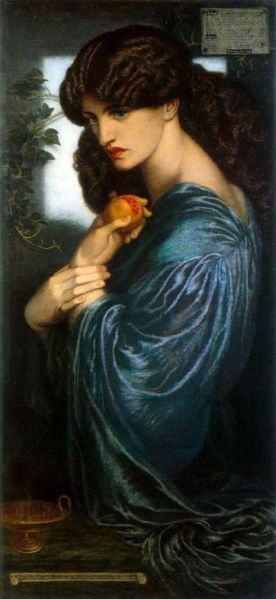
Rossetti's Proserpine


Dante Gabriel Rossetti painted this version of Proserpine in 1874 when he was aged 46.  His favourite model Jane Morris posed for Proserpine, who in classical mythology was kidnapped by Pluto, the god of the underworld, who took her as a wife. The pomegranate in her hand is a symbol of her captivity.

Rossetti and Morris at Kelmscott Manor
Jane was unhappy in her marriage to Rossetti’s friend William Morris so Rossetti fantasised about her as a captive goddess.  The date of this painting is significant as it was in 1874 that Morris had enough of Rossetti’s interest in his wife.  

Kelmscott Manor is a farmhouse near the Thames that William Morris used as a summer home. He signed a joint lease with Rossetti in the summer of 1871 but sent him away from Kelmscott in the July of 1874 and never allowed him to return.

Mary Shellley’s Play Proserpine

Rossetti would have known of Mary Shellley’s play Proserpine which she wrote in 1820 while the Shelleys were living in ItalyHere is the famous prose from Act 1:

I will away, and on the highest top
Of snowy Etna, kindle two clear flames.
Night shall not hide her from my anxious search,
No moment will I rest, or sleep, or pause
Till she returns, until I clasp again
My only loved one, my lost Proserpine

Rossetti's description of Proserpine

In 1888 Rossetti wrote  "She is represented in a gloomy corridor of her palace, with the fatal fruit in her hand. As she passes, a gleam strikes on the wall behind her from some inlet suddenly opened, and admitting for a moment the sight of the upper world; and she glances furtively towards it, immersed in thought. The incense-burner stands beside her as the attribute of a goddess. The ivy branch in the background may be taken as a symbol of clinging memory"

Tuesday, 22 February 2011

Dante Gabriel Rossetti: 'La Donna Della Finestra'


Love's pallor and the semblance of deep ruth
Were never yet shown forth so perfectly
In any lady's face, chancing to see
Grief's miserable countenance uncouth,
As in thine, lady, they have sprung to soothe,
When in mine anguish thou hast lookd on me;
Until sometimes it seems as if, through thee,
My heart might almost wander from its truth.
Yet so it is, I cannot hold mine eyes
From gazing very often upon thine.
In the sore hope to shed those tears they keep;
And at such time, thou mask'st the pent tears rise
Even to the brim, till the eyes wast and pine;
Yet cannot they, while thou art present, weep.


Rossetti's model Jane Morris

First worked as a sketch in chalks in 1877, the version shown here is the oil painting completed in 1879.  The model was Jane Morris, who Rossetti had fallen in love with two years earlier.  It is claimed that Rossetti portrays Jane as 'La Donna Della Finestra' (The Woman in the Window) because she helped him overcome the death of his wife, Elizabeth Siddal – but that was fifteen years earlier in 1862.

A more likely explanation is that although they definitely had a deep emotional relationship, Jane Morris was the wife of Rossetti’s friend William Morris,  so their love allegedly was never sexual and Rossetti became totally obsessed with her. 

Inspiration for 'La Donna Della Finestra'

The idea of the woman in the window was inspired by Dante's Vita Nuova (The life of Nuova), which defined Rossetti's attitudes to love and was translated by him into English in 1850.  The woman appears at the window appears when Dante is grieving for the death of Beatrice and William Michael Rossetti wrote:

'Humanly she is the Lady at the Window; mentally she is the Lady of Pity. This interpretation of soul and body this sense of an equal and undefensible reality of the thing symbolized, and of the form which conveys the symbol this externalism and internalism are constantly to be understood as the key-note of Rossetti's aim and performance in art.