Lord Andrew Lloyd Webber is best known for the musicals that made him a multi-millionaire. He was less well known for his passion in the work of the Pre-Raphaelite Brotherhood - until he presented a documentary where he talks about their work, their lives, and their long term influence.
Growing up in London in the 1960s, he visited local churches and saw the works of Dante Gabriel Rossetti and Edward Burne-Jones in the stained glass windows. He then became a regular visitor to London's Tate Gallery collection in the Pre-Raphaelite gallery.
Interestingly, he explains that unfashionable Victorian paintings could be bought very cheaply at the time. He became wealthy after the hit musical Jesus Christ Superstar in the early 1970's and started what he calls 'serious' art collecting.
He is coy about what it has cost but he has paid record prices at art auctions, paying £17M for a Picasso and his collection includes A Vision of Fiammetta , one of Rossetti's last paintings. Pride of place, of course, goes to one of the eight versions of Rossetti’s ‘Proserpine’.
Andrew Lloyd Webber He makes a good case for their lasting impact not just on art, but also architecture and the way we now think about the Victorians. Disappointingly, he made no mention in the programme of John Ruskin, although there were several opportunities to do so.
The documentary should be available on this link until the 2nd November 2011
Sunday, 30 October 2011
A Passion for the Pre-Raphaelites by Andrew Lloyd Webber
Saturday, 1 October 2011
The Last Pre-Raphaelite
Fiona MacCarthy brings us a little closer to understanding Edward Burne-Jones. You may know her from William Morris: A Life for Our Time and, once again, we are transported to the world of the Victorians.
As Susan Engel wrote: Context is everything - and Fiona MacCarthy reminds us of the need to interpret Burne-Jones through an appreciation of the Victorian imagination. It is no coincidence that Fiona Chose The Beguiling of Merlin for the cover - a painting about love and infatuation, entrapment and betrayal.
Sunday, 17 July 2011
The Pre-Raphaelites Exhibition – London 2012
The Tate Gallery in London has announced a major exhibition of Pre-Raphaelite paintings between the 12th of September 2012 and the 13th of January 2013.
Open from 10am - 6pm daily, the gallery will be exhibiting over 150 works in different media, including painting, sculpture, photography and the applied arts.
The exhibition includes many famous Pre-Raphaelite works rarely seen in the UK, including Rossetti's Found, (on loan from the Delaware Art Museum) Ophelia by John Everett Millais, The Scapegoat by Holman Hunt, the epic social panorama Work by Ford Madox Brown and Rossetti's Lady Lilith.
Rossetti wrote that his Lady Lilith ". . . represents a Modern Lilith combing out her abundant golden hair and gazing on herself in the glass with that self-absorption by whose strange fascination such natures draw others within their own circle."
The Tate also plans to re-introduce a number of rarely seen masterpieces, including Ford Madox Brown’s polemical Work from 1852-1865 and Philip Webb and Burne-Jones’s The Prioress’s Tale wardrobe of 1858.
The Pre-Raphaelites exhibition London event runs from Wednesday 12th September 2012 - Sunday 13th January 2013. Tate Britain is open from 10am - 6pm daily and is open late until 10pm on the first Friday of every month.
Saturday, 18 June 2011
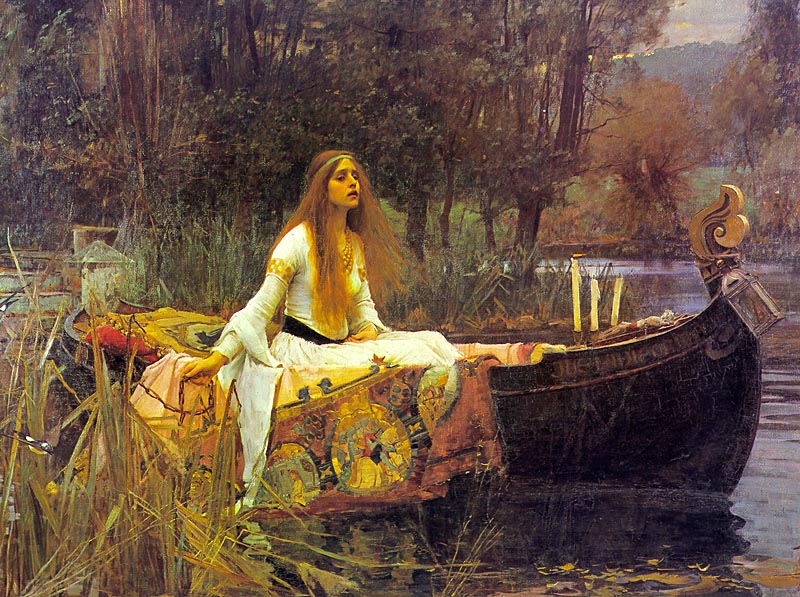
Fascination with The Lady of Shalott
![]() |
| John William Waterhouse |
Alfred Tennyson was only 23 when he first published The lady of Shalott and said he got the idea from a 14th century Italian novella, Donna di Scalotta. Hunt and Rossetti were both inspired to illustrate the haunting poem, which tells how the tragic Lady of Shalott must remain in a tower, separated from the outside world and under a spell that means she dies when she escapes.
Abandoning Shalott, her mythical island, the Lady steals a boat and finds time to write her name on the bows before drifting down the river to Camelot to find love. Sadly the curse means she dies before she arrives and is found (too late) by the gallant knight Sir Lancelot. It is this scene which Dante Gabriel Rossetti chose to illustrate, where all Lancelot's has to say on finding the body is "She has a lovely face". Rossetti wrote in a letter to Hunt that "illustrated editions of poets, however good are quite hateful things" but this didn't seem to stop him as he made numerous preparatory sketches before he was happy with his woodcut.
![]() |
| Rossetti: The lady of Shalott (Woodcut) Credit The Rossetti Archive |
Hunt’s painting of The Lady of Shalott was his last work, completed at the age of 87 and captures a very different moment – when the mirror cracks and the spell is broken.
![]() |
| Hunt: The Lady of Shalott |
Postscript: Support Stephanie Pina
The husband of Stephanie Pina, creator of LizzieSiddal.com was recently injured in a motorcycle accident and the family face significant medical expenses. (see Stephanie's Blog) You can help by buying The Lady of Shalott DVD
Monday, 16 May 2011
Supreme Surrender - Dante Gabriel Rossetti
To all the spirits of love that wander by
Along the love-sown fallowfield of sleep
My lady lies apparent; and the deep
Calls to the deep; and no man sees but I.
The bliss so long afar, at length so nigh,
Rests there attained.
Methinks proud Love must weep
When Fate’s control doth from his harvest reap
The sacred hour for which the years did sigh.
Taught memory long to mock desire: and lo!
Across my breast the abandoned hair doth flow,
Where one shorn tress long stirred the longing ache:
And next the heart that trembled for its sake
Lies the queen-heart in sovereign overthrow.
Sunday, 15 May 2011
Millais and Sophy Gray
Sophia (Sophy) Gray was just thirteen when she posed for this painting, which has been called one of the most remarkable realist portraits of the nineteenth century.
As well as being one of the founders of the Pre-Raphaelite Brotherhood, Millais married Ruskin's former wife Effie Gray, who was Sophy's older sister and there is evidence that Sophy was a 'go between' for her sister, taking messages to Millais and helped her Effie elope.
Inevitably Millais fell in love with both sisters and began drawing Sophie when she was just 10 years old. Millais wrote 'What a delightful little shrewd damsel Sophia is. I think her extremely beautiful and that she will even improve, as yet she does not seem to have the slightest idea of it herself which makes her prettier - I am afraid that ignorance cannot last long.'
Sophy became the model for many of Millais' Pre-Raphaelite paintings. Their relationship eventually became unacceptable when she twenty four and Effie sent her sister away. The trauma of the separation led to Sophy having a nervous breakdown. It was five years before she recovered enough to meet and marry Sir James Key Caird, a wealthy businessman. It was not a happy marriage and Sophy, suffering from anorexia, committed suicide nine years later in 1882. Sir John Millais was knighted in 1885 and was the first artist to be made a Baronet. He became President of the Royal Academy in 1896 but sadly died the same year.
Friday, 29 April 2011
The Seed of David Triptych - Dante Gabriel Rossetti
Llandaff Cathedral is a few minutes drive from where I live in Cardiff , so I have finally had a closer look at Rossetti’s triptych called “The Seed of David”. It was commissioned in 1856 as a backdrop for the altar but was moved to safe storage during the war, which was just as well as the cathedral was severely damaged by a German landmine.
The triptych is found behind wrought iron railings in a small chapel to the left as you enter the main door. There was once a stern notice forbidding photography but this has now gone and the cathedral staff were happy for me to take some pictures.
As far as I can tell the work has only left the cathedral in 2003/4, when it was the centrepiece of a touring exhibition of Rossetti’s works which were displayed in Liverpool and Amsterdam .
The centre panel is an Adoration of the Magi, with David to the left as a young boy and on the right as a king. Rossetti wrote a letter to Charles Eliot Norton in 1858 when he was working on the triptych, saying he was planning to paint "the Nativity; for the side pieces to which I have David as Shepherd and David as King — the ancestor of Christ, embodying in his own person the shepherd and king who are seen worshipping in the Nativity".
William Morris posed for David as a young man and Jane Morris was of course Rossetti’s only choice for the model for the Virgin Mary in the central nativity panel.
Subscribe to:
Posts (Atom)